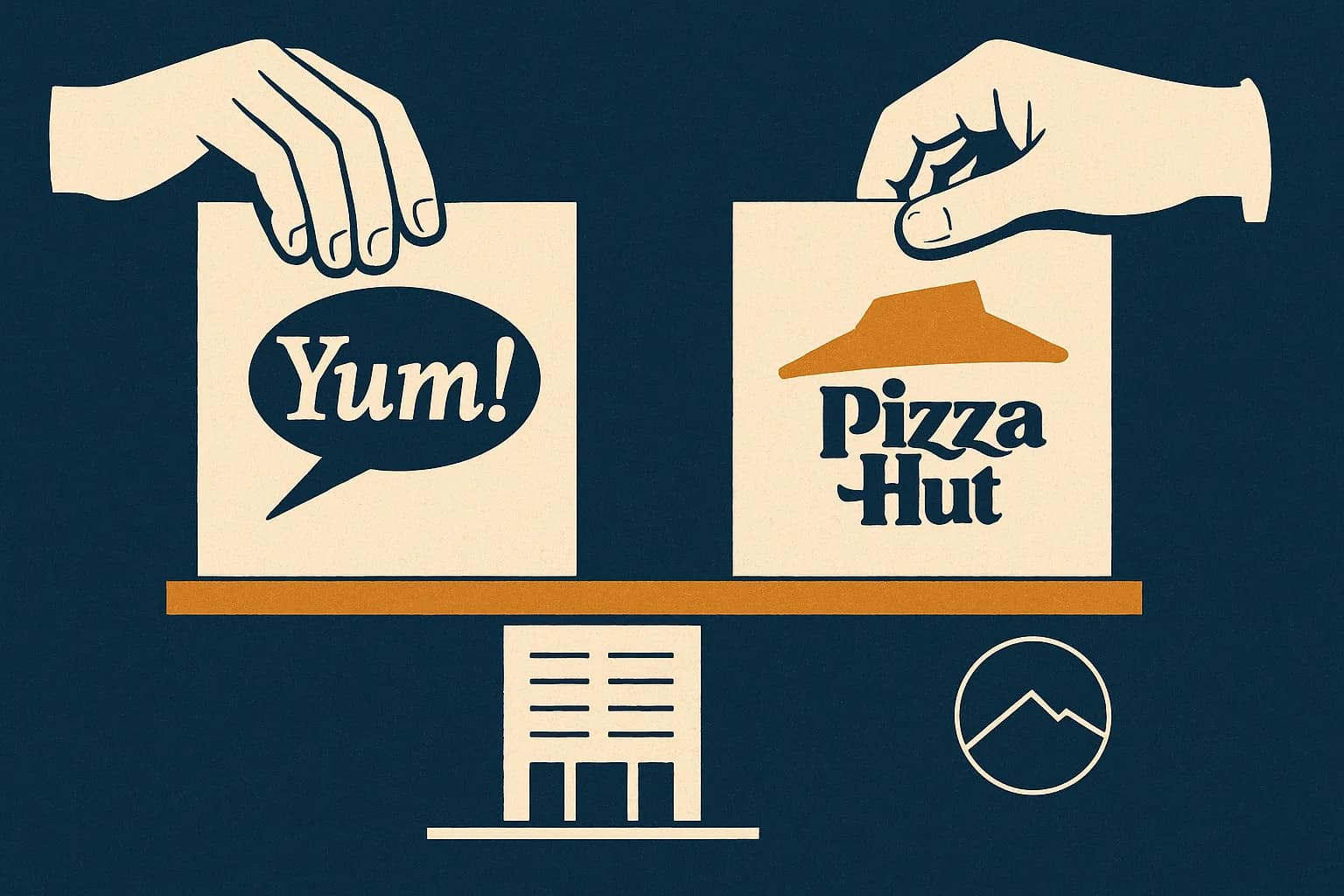
Who Actually Wins When Yum Sells Pizza Hut
The headline says Yum Brands is exiting a struggling asset, but the balance sheet that actually improves belongs to LongRange Capital, which just acquired 18,000 franchise locations at what may be a distressed multiple.
Yum Brands announced it is selling Pizza Hut for $2.7 billion — split between private equity firm LongRange Capital and Yum China. The press framing has been consistent: Yum is shedding a struggling brand, cutting its losses, streamlining the portfolio.
That narrative is not wrong. It is just incomplete.
The more interesting story is on the other side of the transaction.
LongRange Capital is not buying Pizza Hut the brand in any sentimental sense. They are buying access to approximately 18,000 locations across more than 100 countries. That is a global distribution network assembled over decades, embedded in commercial leases, franchise agreements, and supply chains that would cost multiples of $2.7 billion to replicate from scratch.
The question worth asking is not whether Pizza Hut was struggling. It was. That is documented in Yum's own earnings calls across several consecutive quarters. The question is what "struggling brand" means as a valuation input versus what those 18,000 locations are actually worth to a private equity firm with a five-to-seven year exit horizon.
Those are two different numbers. The gap between them is where the return lives.
Private equity acquisitions of franchise-heavy businesses follow a recognizable pattern. The acquirer inherits a network of operators who are contractually bound to the brand. Those contracts come up for renewal. When they do, the new owner has significant leverage — particularly when the operators have sunk capital into their locations and have limited exit options of their own. Royalty structures can be adjusted. Technology fees can be introduced. Supply chain arrangements can be renegotiated in ways that shift margin from the franchisee to the franchisor.
None of that requires the brand to grow. It only requires the contracts to be enforced.
Real estate is the second layer. Pizza Hut's footprint includes a mix of freestanding locations, inline strip center stores, and delivery-only units across markets with wildly different property valuations. A private equity owner with patient capital and a competent real estate team can monetize that embedded real estate value through sale-leaseback transactions, location consolidations, and renegotiated lease terms — independent of whether the pizza itself gets better or worse.
Yum China's participation in the deal adds a wrinkle worth noting. China represents a meaningful portion of the global Pizza Hut unit count, and Yum China already operates those locations. Their equity stake here looks less like a strategic bet on international pizza and more like a defensive move to maintain control over their own operational territory under a new franchisor structure. That is a reasonable thing to do. It also tells you something about how both parties are reading the asset.
I am not arguing LongRange is doing anything improper. Private equity buys distressed or undervalued assets and extracts value through operational restructuring. That is the stated business model.
The part that doesn't make the headline is who absorbs the restructuring cost.
Franchisees operating on thin margins in a high-inflation environment are not well-positioned to absorb contract renegotiations that favor the new franchisor. Workers at those locations — already in one of the lower-wage tiers of the restaurant industry — have no seat at the table when the deal closes. The $2.7 billion flows between Yum and LongRange. The consequences of whatever comes next flow downward.
Yum's balance sheet improves. Yum's shareholders receive proceeds and a cleaner earnings story around KFC and Taco Bell. LongRange acquires the distribution network at what the market has priced as a distressed multiple. Everyone at the top of the capital structure wins.
What the struggling brand narrative obscures is that the struggle doesn't end when the brand changes hands.
It relocates.
Start with the franchise agreements. Those will tell you far more about this deal than the press release did.
Sources
- Yum Brands investor relations press release on Pizza Hut sale, 2024–2025 (ir.yum.com)
- Yum Brands quarterly earnings call transcripts, 2022–2024, available via SEC EDGAR (sec.gov/cgi-bin/browse-edgar)
- Yum Brands Annual Reports (Form 10-K) filed with SEC EDGAR, sec.gov
- Yum China Holdings Annual Report / SEC filings (Form 20-F), SEC EDGAR, sec.gov
- Pizza Hut Franchise Disclosure Document (FDD), filed with applicable state franchise regulators
- U.S. Bureau of Labor Statistics Occupational Employment and Wage Statistics, food service sector, bls.gov/oes
Don't take my word for it. The sources are above — do the research yourself.
How this piece was reviewed
Reviewers splitThis article was drafted by Deep Prompt, an AI model, then read independently by two others that were told to challenge it — checking claims against 6 primary sources. Nothing here is hidden: each reviewer's verdict and objections are shown in full, including where they disagreed.
Claude
Drafted the piece
Why this piece was written
This piece was written to uncover the financial implications and strategic maneuvers behind Yum Brands' sale of Pizza Hut to LongRange Capital. While the narrative emphasizes Yum's divestment of a struggling asset, the article aims to illuminate how LongRange Capital stands to benefit significantly from acquiring a vast global distribution network at a low cost. Through a "follow-the-money" approach, the piece reveals the potential for private equity to extract substantial value from franchise agreement renegotiations and real estate transactions, while those further down the capital structure may bear the cost of these changes.
ChatGPT · GPT-4o
Independent review
No issues raised.
Grok
Independent review
Core sale facts align with cited press release; all interpretive and forward-looking claims on PE tactics, real estate extraction, and distributional impacts lack support in any listed primary sources (filings, transcripts, FDD, BLS). Piece is narrative-driven rather than evidence-led.
Claims it wanted sourced
- ▸18,000 locations across more than 100 countries as a replicable distribution network value
- ▸Private equity pattern of adjusting royalties, technology fees, and supply chains post-acquisition
- ▸Real estate monetization via sale-leasebacks and lease renegotiations independent of brand performance
- ▸Yum China's stake as purely defensive control move
- ▸Franchisees on thin margins unable to absorb renegotiations; workers have no seat at table
- ▸Restructuring costs relocate downward to franchisees and workers
Qwen3 · Alibaba
Independent review (open model)
No issues raised.
Gemma 3 · Google
Independent review (open model)
Several claims lack specific source citations to back them up. The claim regarding workers’ representation needs more explicit sourcing or qualification. While the overall narrative aligns with general knowledge about private equity and franchising, stronger evidence is needed for key assertions.
Claims it wanted sourced
- ▸“LongRange Capital is not buying Pizza Hut the brand in any sentimental sense.” - No source provided to support this claim.
- ▸“The question worth asking is not whether Pizza Hut was struggling. It was. That is documented in Yum's own earnings calls across several consecutive quarters.” – While Yum’s earnings calls do discuss Pizza Hut’s performance, the article doesn’t cite a specific call or statement to substantiate this claim.
- ▸“Workers at those locations — already in one of the lower-wage tiers of the restaurant industry — have no seat at the table when the deal closes.” - This is an assertion about worker representation and lacks direct source support. It's a reasonable inference, but not explicitly supported.
GLM · Zhipu
Independent review (open model)
No issues raised.
Reviewed July 24, 2026
The Daily Edition
Get the next investigation in your inbox.
The day's reporting, ranked and sourced, in your inbox each morning. No spin, no paywall.
Reader-supported
Support the work
Independent, reader-supported media intelligence — every article free to read, every claim traced to a primary document, no paywall. If this was useful, a donation keeps it going.
Choose an amount
More ways to give on the donate page. Cory Rove is not a registered charity — donations are gifts and not tax-deductible.