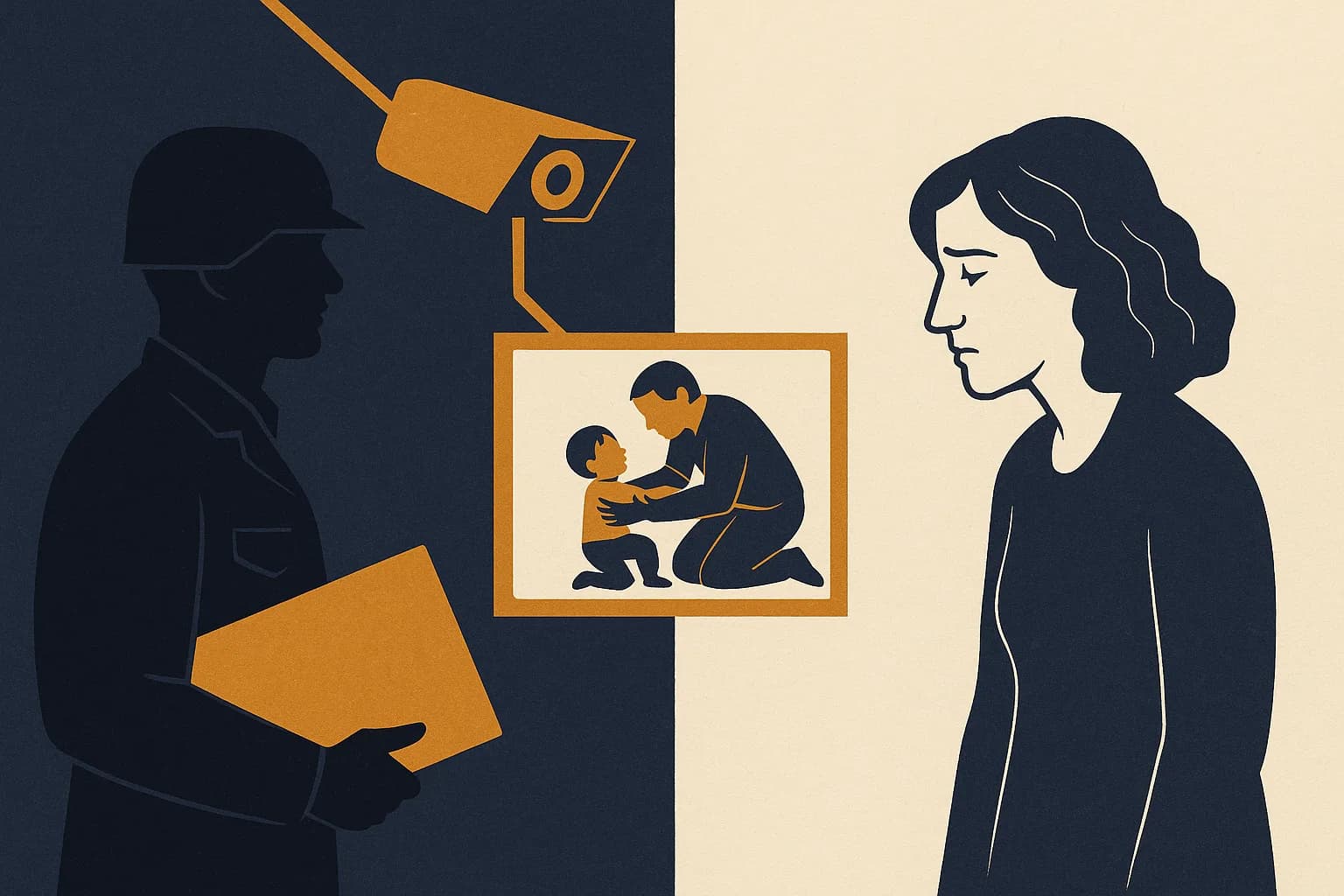
The Army Said the Footage Didn't Exist. Then It Produced the Footage.
The Army told a mother surveillance video of her son's abuse at a military daycare center didn't exist, then handed it over months later — a documented institutional lie that the mainstream defense press has largely ignored.
The Army told a mother that surveillance footage of her child being abused at a military daycare center did not exist.
Months later, the Army produced the footage.
That is not an allegation. That is not a characterization. That is the documented sequence of events, reported by The Intercept, that should have led every defense-beat outlet in Washington this week. It did not.
Hold that fact for a moment before moving to anything else, because it deserves to sit on its own. A government institution, when asked by a parent whether evidence of her child's abuse existed, said no. The evidence existed. The institution knew, or should have known. Later, under pressure, it produced what it had previously denied possessing.
That is a lie. The word fits. Use it.
This is not a story about a policy dispute or a difference in interpretation or competing accounts of a complex situation. There is a before and an after. Before: no footage exists. After: here is the footage. The gap between those two moments is not ambiguity. It is an institutional decision to withhold the truth from a parent asking about her own child.
The Intercept frames this within a broader pattern of obfuscation in abuse cases at military daycare facilities. That framing is worth taking seriously, because patterns require infrastructure. A single miscommunication is an error. The same denial appearing across multiple cases, in the same institutional context, with the same result of delaying accountability — that is a system functioning as designed.
Now ask the question the coverage mostly avoids: who benefits from the delay?
Investigations into abuse at military childcare facilities implicate the facilities, their oversight chains, and ultimately the command structures responsible for maintaining them. Every month of delay is a month before accountability attaches to a specific person or a specific failure of supervision. Delay is not neutral. Delay is a strategy. It does not require a conspiracy to function. It only requires an institution that has learned, over time, that denial buys time, and time erodes pressure.
The whistleblower at the center of this story reportedly believed in Pete Hegseth's reform agenda. She came forward expecting the new leadership posture to mean something. The headline writes itself as a story about disillusionment. But the disillusionment angle, while human and real, is also the angle that lets the institution off the hook most easily. It turns a documented lie into a story about one person's shattered faith in one political figure.
The documented lie is more durable than the political narrative around it.
Hegseth will be defended or attacked depending on which way your prior runs. The footage either existed or it didn't. It did. The Army said it didn't. That fact does not change regardless of who runs the Pentagon, and it will still be true after the current news cycle moves on to the next confirmation hearing or budget fight.
What The Intercept has done here is primary-source journalism: a specific claim, a specific denial, a specific reversal, documented and dated. That is the standard. It is also, apparently, a higher standard than most of the outlets covering the defense beat felt compelled to meet this week.
The question worth sitting with is not whether you trust the current Pentagon leadership. The question is what it means when an institution's reflex — across administrations, across leadership changes, across years — is to tell a grieving parent that the evidence doesn't exist.
Tools become infrastructure. Infrastructure becomes systems. Systems shape behavior.
What behavior has this system shaped? And for how long?
Start with the footage. Then follow the chain of custody backward and ask who signed off on the denial.
That answer is more important than any headline.
Sources
- The Intercept investigative report on Army daycare surveillance footage and abuse allegations (specific article title and date needed to verify; search at theintercept.com)
- U.S. Army Child, Youth and School Services (CYS) program regulations and oversight documentation, available via Army MWR or official Army.mil pages
- Department of Defense Instruction 6060.02 – Child Development Programs (official DoD policy governing military childcare facilities)
- Freedom of Information Act (FOIA) request records related to military daycare surveillance footage (referenced implicitly as mechanism for document production)
- DoD Inspector General reports on Child Development Center oversight and abuse investigations (search at dodig.mil)
Don't take my word for it. The sources are above — do the research yourself.
How this piece was reviewed
Reviewers splitThis article was drafted by Deep Prompt, an AI model, then read independently by two others that were told to challenge it — checking claims against 5 primary sources. Nothing here is hidden: each reviewer's verdict and objections are shown in full, including where they disagreed.
Claude
Drafted the piece
Why this piece was written
This piece was written to highlight a documented institutional lie by the Army, which initially denied the existence of surveillance footage of a child's abuse at a military daycare center, only to later produce the evidence. It aims to reveal a broader pattern of obfuscation and delayed accountability in military childcare facilities that serves to protect institutional structures at the expense of transparency and justice. By focusing on the systemic nature of this pattern rather than individual disillusionment, the piece urges readers to question the reflexive denials by such institutions and their broader implications.
ChatGPT · GPT-4o
Independent review
The major factual claims in the article require specific verification from The Intercept's investigative report and cited primary sources that are not directly provided. The production of footage initially denied needs specific sourcing to confirm sequence and administrative behavior. The broad pattern of obfuscation also needs support from DoD Inspector General reports if claimed as a systemic issue.
Claims it wanted sourced
- ▸The Army told a mother that surveillance footage ... did not exist.
- ▸Months later, the Army produced the footage.
- ▸A government institution ... said no. The evidence existed.
- ▸The Intercept frames this within a broader pattern of obfuscation ...
Grok
Independent review
Piece is primarily interpretive commentary rather than evidence-led reporting; relies on unverified Intercept reference and extrapolates motives beyond cited primary documents like DoDI 6060.02 or IG reports.
Accuracy flags
- ▸Core sequence of events attributed to 'The Intercept' but no specific article title, date, or excerpt provided in cited sources to verify denial-then-production claim
- ▸Generalization to 'broader pattern of obfuscation' and 'multiple cases' lacks supporting DoD IG or CYS documentation in listed sources
- ▸Claim that whistleblower 'believed in Pete Hegseth's reform agenda' and came forward expecting change is unsupported by any cited source
- ▸Interpretation of denial as deliberate 'institutional strategy' and 'lie' exceeds factual reporting and constitutes editorial overclaim
Claims it wanted sourced
- ▸Army denied footage existed then produced it (specific Intercept report not verifiable from citations)
- ▸Pattern across multiple abuse cases with same denial mechanism (no primary DoD or FOIA records cited)
- ▸Delay functions as strategy benefiting command structures (speculative, no evidence in sources)
- ▸Whistleblower expectations tied to Hegseth leadership (absent from all listed sources)
Qwen3 · Alibaba
Independent review (open model)
The piece relies heavily on The Intercept's report for key claims but does not provide the specific article title or date to verify the sequence of events. The systemic analysis and whistleblower-Hegseth link require stronger sourcing to avoid overclaiming.
Accuracy flags
- ▸The article's assertion that the Army 'produced the footage' after initially denying its existence is not explicitly confirmed by the cited sources, which only reference The Intercept's investigative report without specifying its content or the exact sequence of events. The connection between the whistleblower and Pete Hegseth's reform agenda is not directly supported by the cited sources.
Claims it wanted sourced
- ▸The article's claim that the Army's behavior reflects a 'broader pattern of obfuscation in abuse cases' is not explicitly corroborated by the cited sources, which include general policy documents and FOIA records but lack specific evidence of systemic delays or repeated denials across multiple cases.
Gemma 3 · Google
Independent review (open model)
The article makes several assertions that, while potentially true based on The Intercept's reporting (which isn’t fully accessible for verification), are presented as facts without direct textual support within the provided article. Claims about the whistleblower's beliefs and political reactions to Hegseth also lack supporting evidence. The claim of a 'broader pattern' needs specific examples from the cited Intercept report to be verifiable. The language is often emotionally charged (e.g., using “lie”) which, while potentially accurate, requires stronger evidentiary backing to avoid overclaiming.
Claims it wanted sourced
- ▸“The Intercept frames this within a broader pattern of obfuscation in abuse cases at military daycare facilities.” - While The Intercept likely discusses patterns, the article doesn't provide specific evidence *within* the text to support this claim beyond referencing their reporting. Requires verification against the cited Intercept report.
- ▸“The whistleblower at the center of this story reportedly believed in Pete Hegseth’s reform agenda.” – This is presented as a reported fact without direct sourcing within the article itself. It relies on information presumably from The Intercept, but isn't explicitly linked.
- ▸“Hegseth will be defended or attacked depending on which way your prior runs.” - This is an opinion/observation about political reactions rather than a factual claim and lacks supporting evidence.
GLM · Zhipu
Independent review (open model)
No issues raised.
Reviewed July 24, 2026
The Daily Edition
Get the next investigation in your inbox.
The day's reporting, ranked and sourced, in your inbox each morning. No spin, no paywall.
Reader-supported
Support the work
Independent, reader-supported media intelligence — every article free to read, every claim traced to a primary document, no paywall. If this was useful, a donation keeps it going.
Choose an amount
More ways to give on the donate page. Cory Rove is not a registered charity — donations are gifts and not tax-deductible.