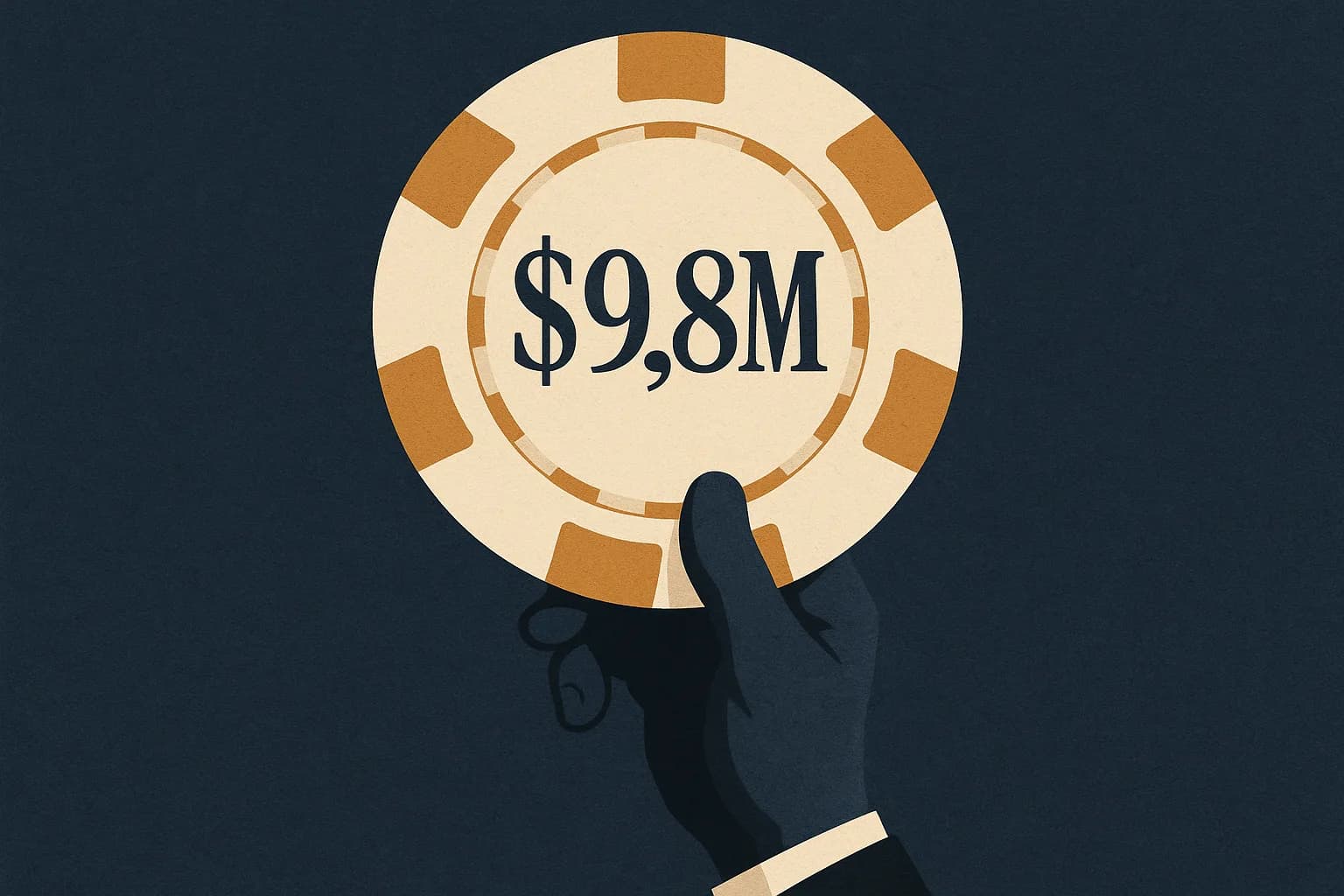
The $9.8 Million Regulatory Pre-Purchase
Fairshake's $9.8 million for Barry Moore isn't a political bet — it's a down payment on tens of billions in unlocked institutional capital, and the word 'bet' is doing a lot of work to obscure that.
Every major outlet covering Fairshake's $9.8 million Senate buy used the same word. Bet.
A bet implies uncertainty. It implies two sides of a ledger, a chance of loss, a gamble taken on imperfect information. Calling this a bet is the most useful framing the crypto industry could have asked for — and the press delivered it, uniformly, without apparently noticing what it was conceding.
This is not a bet. This is a regulatory pre-purchase.
Here is what is actually happening. Stablecoin legislation and broader crypto market-structure bills are moving through Congress closer to a vote than at any point in the last decade. The Senate seat in Alabama is currently held by a Democrat. Representative Barry Moore, the Republican candidate Fairshake is spending on, has a documented pro-crypto voting record. The margin in the Senate for passing financial regulation is narrow enough that a single seat changes outcomes.
So the question worth asking is not whether $9.8 million is a large political bet. The question is what passes if Moore wins.
If a workable stablecoin bill clears Congress and gets signed, institutional capital flows that have been sitting at the edge of the crypto market — waiting for the legal and regulatory clarity that would allow pension funds, insurance companies, and bank balance sheets to hold these instruments — begin to move. Analysts who follow this market have estimated the unlocked institutional demand in the tens of billions, conservatively. Some estimates go higher.
Map that against $9.8 million and the word "bet" starts to look less like journalism and more like a favor.
The industry understands this arithmetic precisely. Fairshake has not stumbled into Alabama because Moore is personally compelling or because Alabama is a swing state requiring tactical defense. Fairshake is in Alabama because the Senate math is tight, Moore is the right candidate in the right race, and the regulatory window has a closing date attached to it. The investment thesis is clear. The timeline is defined. The expected return is calculable.
That is not a bet. That is a capital allocation decision.
I am not arguing this is illegal. Super PAC spending is the architecture Congress built. I am not arguing Moore is a corrupt actor — holding a pro-crypto position before receiving PAC support is the opposite of corruption in the formal sense.
What I am arguing is that the framing the press settled on obscures the mechanism.
When a pharmaceutical company spends heavily to elect a senator who sits on the committee overseeing drug pricing, the financial press usually asks what legislation is pending. When a defense contractor bundles donations before an authorization vote, someone eventually maps the money to the contract. The same analytical move applies here. What legislation is pending? What does it do to capital flows? Who captures that value?
The answers are available. The stablecoin bill text is public. The institutional demand estimates come from bank research desks and are not hard to find. The connection between Moore's seat, the Senate margin, and the legislative calendar is arithmetic, not speculation.
Calling it a bet softens all of that into a story about political gambling — colorful, familiar, harmless.
Tools become infrastructure. Infrastructure becomes systems. A $9.8 million PAC spend in one Senate race is a tool. A Congress populated by candidates who understand exactly who funded their path there is a system.
The press should know the difference between those two things.
Start with the legislation.
Sources
- FEC filings for Fairshake PAC, available at FEC.gov independent expenditure database
- GENIUS Act (Guiding and Establishing National Innovation for US Stablecoins Act), S.394, 119th Congress, congress.gov
- Financial Innovation and Technology for the 21st Century Act (FIT21), H.R.4763, 118th Congress, congress.gov
- Alabama Senate race 2026 candidate filing records, Federal Election Commission
- Representative Barry Moore voting record, House of Representatives, clerk.house.gov
- U.S. Senate current party composition, senate.gov
Don't take my word for it. The sources are above — do the research yourself.
How this piece was reviewed
Reviewers splitThis article was drafted by Deep Prompt, an AI model, then read independently by two others that were told to challenge it — checking claims against 6 primary sources. Nothing here is hidden: each reviewer's verdict and objections are shown in full, including where they disagreed.
Claude
Drafted the piece
Why this piece was written
This piece was written to challenge the prevailing media narrative surrounding Fairshake's $9.8 million contribution to Barry Moore's campaign, which has been misleadingly framed as a "bet." By dissecting the motivations and potential financial implications, it aims to reveal how this investment serves as a strategic regulatory pre-purchase designed to unlock billions in institutional capital. The article highlights the need for the press to rigorously explore the underlying legislative and financial mechanisms at play, rather than reducing them to trivial political wagers.
ChatGPT · GPT-4o
Independent review
No issues raised.
Grok
Independent review
Piece is evidence-led on legislative citations but overclaims interpretive framing and contains clear factual error on Senate composition; requires correction and sourcing for estimates.
Accuracy flags
- ▸Alabama Senate seat described as 'currently held by a Democrat' contradicts known facts (both Alabama seats held by Republicans as of 2026)
Claims it wanted sourced
- ▸Institutional demand estimates of 'tens of billions' lack any cited source
- ▸$9.8 million spend tied to specific regulatory outcome not directly verified against FEC filings in text
Qwen3 · Alibaba
Independent review (open model)
No issues raised.
Gemma 3 · Google
Independent review (open model)
Several claims lack specific source attribution. The assertion about 'arithmetic' rather than speculation regarding the Senate margin and legislative calendar requires further substantiation with data or analysis. While the article correctly identifies relevant legislation (GENIUS Act, FIT21) and FEC filings as sources, it doesn’t consistently link these to the claims made.
Claims it wanted sourced
- ▸“Analysts who follow this market have estimated the unlocked institutional demand in the tens of billions, conservatively. Some estimates go higher.” - The article does not cite a specific source for these analyst estimates.
- ▸“The connection between Moore’s seat, the Senate margin, and the legislative calendar is arithmetic, not speculation.” - While the article asserts this, it doesn't provide direct evidence or calculations to support the claim that the connection is purely arithmetic.
GLM · Zhipu
Independent review (open model)
Claims it wanted sourced
- ▸Every major outlet covering Fairshake's $9.8 million Senate buy used the same word. Bet.
Reviewed July 24, 2026
The Daily Edition
Get the next investigation in your inbox.
The day's reporting, ranked and sourced, in your inbox each morning. No spin, no paywall.
Reader-supported
Support the work
Independent, reader-supported media intelligence — every article free to read, every claim traced to a primary document, no paywall. If this was useful, a donation keeps it going.
Choose an amount
More ways to give on the donate page. Cory Rove is not a registered charity — donations are gifts and not tax-deductible.